
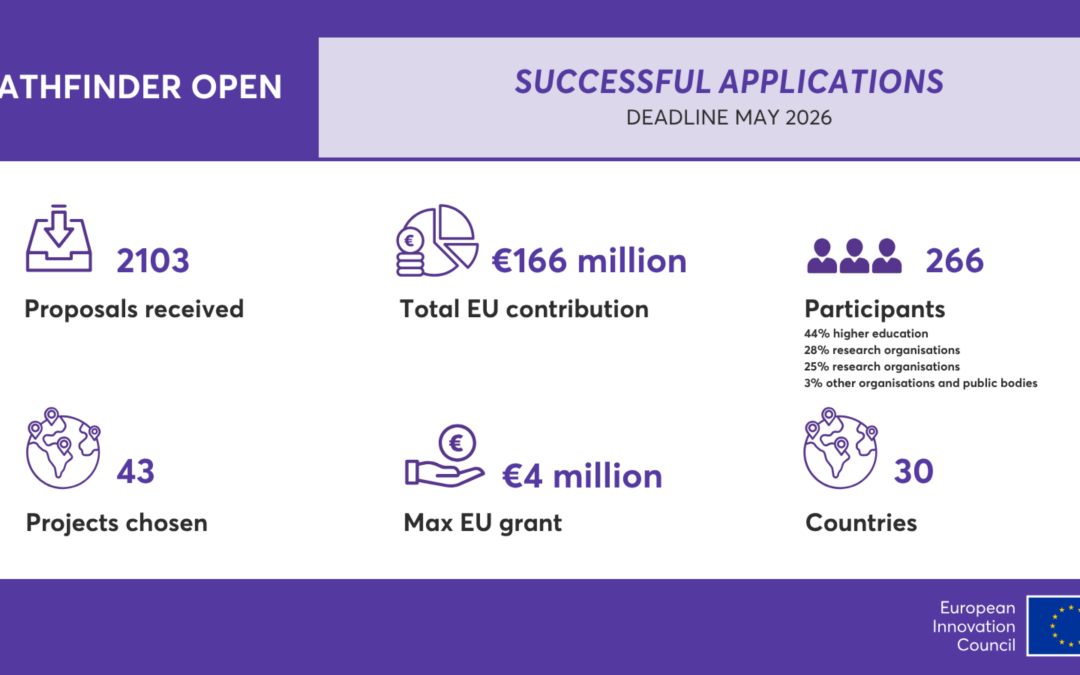
The European Innovation Council (EIC) has selected 43 groundbreaking projects under the EIC Pathfinder Open 2026 call, each of them receiving up to €4 million in grant funding. From pioneering cancer treatments and quantum computing to advanced manufacturing and climate-resilient technologies, these projects aim to push the boundaries of scientific discovery and lay the foundations for tomorrow's breakthrough innovations.
The 2026 call received for the second consecutive year a record number of proposals, making the Pathfinder open call one of the Horizon Europe most competitive calls and showing the relevance of bottom-up funding.
The selected projects bring together 218 organisations from 30 countries, including 24 EU Member States. Across the 266 consortium participations, 44% are from higher or secondary education establishments, 28% are from research organisations, 25% are from private companies, and 3% are from other organisations and public bodies. SMEs participate in 34 of the selected projects.
Examples of projects selected include:
- LUNGBOT – Turning lung tumours into local treatment factories
LUNGBOT is developing a radically new approach to lung cancer treatment using inhalable, engineered bacteria. Rather than delivering medicines throughout the body, the project aims to enable these bacteria to reach tumours and produce therapeutic molecules directly where they are needed. This innovative approach could pave the way for more targeted cancer treatments and help overcome some of the limitations of conventional therapies.
- NoBIQu – Making quantum computing more reliable and accessible
NoBIQu aims to overcome one of the biggest obstacles to practical quantum computing: errors that disrupt quantum calculations. By developing a new architecture combining superconducting quantum bits with more efficient error-correction methods, the project seeks to dramatically reduce the hardware needed for reliable quantum computation. If successful, this could bring large-scale, fault-tolerant quantum computers closer to reality.
- DyHoLIT – Pushing the boundaries of precision manufacturing
DyHoLIT is exploring a new generation of holographic lithography capable of creating extremely small and complex structures with exceptional precision. By combining programmable optical technologies with advanced mathematical algorithms, the project aims to overcome existing limits in high-resolution manufacturing. Potential applications include next-generation semiconductor technologies and the fabrication of complex three-dimensional structures for biomedical research.
- DEW2ROOT – Helping plants survive drought by harvesting moisture from the air
DEW2ROOT is developing an innovative, wood-based technology that captures atmospheric moisture and delivers it directly to plant roots, without relying on conventional irrigation systems. Inspired by the principle of a diode, the proposed material is designed to transport water in one direction, from the surrounding environment towards the soil. This sustainable approach could help young plants survive increasingly frequent droughts and support climate-resilient agriculture and ecosystem restoration.
Next steps
All projects have been notified of the results and are now preparing their grant agreements. Funding will be dependent upon the signing of these agreements.