
KEY TAKEAWAYS
Advanced industries play an unusually large role in South Korea’s economy. Ten key sectors, including electronics, machinery, vehicles, and chemicals, accounted for 25.1 percent of its economy in 2022—more than twice their share of the global economy.
South Korea’s AI-memory boom is real, but it does not secure the country’s wider industrial system. The risk is that its industrial base could gradually narrow, not that it could suddenly collapse.
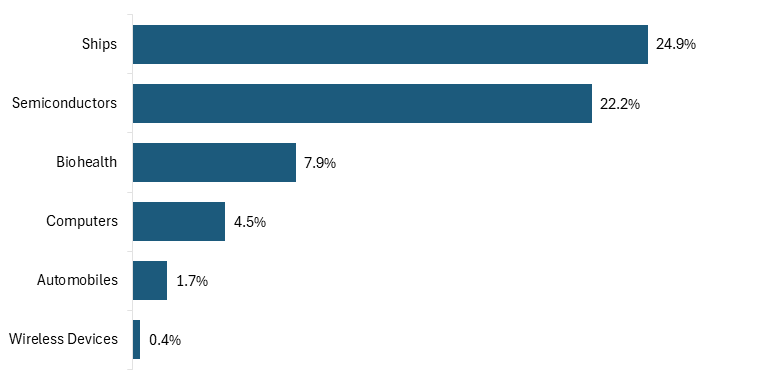
China’s scale increasingly overlaps with Korea’s strongest sectors. From 2018 to 2022, China added $611.5 billion in output in the same 10 advanced sectors that made up a quarter of Korea’s economy, while Korea added only $7.4 billion.
To turn the AI-memory boom into systemic strength, Korea should make first-to-the-world innovation its primary domestic strategy. That will require stronger R&D incentives for large firms and faster commercialization of frontier technologies.
Korea also should build allied scale, beginning with Japan; coordinate measures against unfair Chinese practices; and make public support conditional on productivity, commercial qualification, firm growth, and exports.