
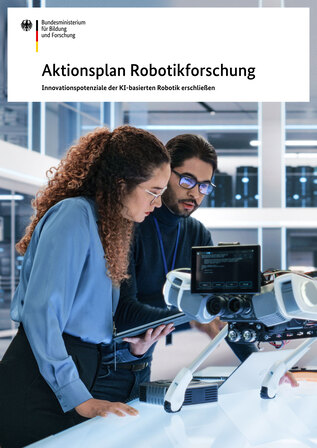
"Action Plan for Robotics Research" was published on 20 November 2023, implementing its future "Research and Innovation Strategy" and "Artificial Intelligence Action Plan."
Germany is the largest robotics market in Europe
Flexible automation between sectors through robotics based on artificial intelligence (AI) will be essential in the future to ensure and strengthen competitiveness. Accordingly, the market potential for robotics is estimated at EUR 260 billion in 2030, with additional impacts on other industrial sectors. Germany has the fourth highest density of robots in the world. Robotics is experiencing, mainly due to the use of artificial intelligence (AI), a drastic expansion of its possibilities of use, creating intelligent systems that perform complex tasks in unstructured environments either alone or with humans in teamwork. The Federal Ministry of Education and Research (BMBF) supports research into robotics, basic technologies and applications with more than €40 million per year. Projects range from AI-based robotic algorithms and innovative sensors, to intelligent robots for crafts, robots for rescuers and service robots to relieve the burden on caregivers.
The Federal Ministry of Education and Research (BMBF) has identified four specific areas of action where there is the most urgent need for action:
- Implement innovations in basic technologies usable for robotics
• The Federal Ministry of Education and Research (BMBF) will continue and further expand its research, young talents and, in particular, SME funding in the areas of AI and software engineering. Artificial intelligence and software engineering are also being explored in the application field of robotics, for example through several AI professorships and AI junior research groups, or in AI competence centers. The Federal Ministry of Education and Research (BMBF) also supports research into AI's technological foundations such as explainability, robustness and transfer learning.
• In the field of networking and security of digital systems, the Federal Ministry of Education and Research (BMBF) will continue its financial activities for low-latency and highly reliable communication systems, and continue to address the important foundations of network robotics. For example, the "National 6G Initiative" develops highly relevant radio technologies for sensory environmental detection, control of low-latency robotic systems over communication networks, rapid sensor technologies, or distributed computing architectures for robotic applications. Overall, the funding activities will support robotic solutions in Industry 4.0, as well as in medicine, health and civil security.
• In microelectronics, the Federal Ministry of Education and Research (BMBF) focuses on "edge computing" and hardware for AI-based applications. Another focus is intelligent sensor technology, which is the basis for safe interaction between robots in challenging environments.
2. Pooling and networking of cutting-edge robotics research
• With the creation of a decentralised robotics institute, current cutting-edge research will be brought together at the forefront of robotics in Germany.
• In the first phase of enlargement, a governance structure with a common point of contact is to be set up to represent the cooperation network as an office and contact person for cooperation worldwide. The aim is to continuously promote networking with all relevant stakeholders in the robotics ecosystem and to strategically align national robotics research with the resulting platform. This includes elaboration of ethical, legal and social aspects, science communication and participatory formats, as well as joint research roadmaps and access concepts for robotic infrastructures of partners at the "Robotics Institute Germany".
• For effective collaboration at the "Robotics Institute Germany", a common data platform for research and development is envisaged, accelerating the development of adaptive robotic systems through data exchange.
3. Supporting skilled workers for the robotics of the future
• The "Robotics Institute Germany" in Germany is to be expanded into a "talent hatchery" through targeted training and further education measures. The "Robotics Academy" is intended to use the expertise and capacities of a decentralised institute to develop and establish a state-of-the-art academic programme with modules for academic and vocational training and further education.
• Existing educational institutions (universities, vocational schools, continuing education institutions) should be able to make a big leap in quality throughout Germany, which will also be reflected in teaching robotics at an excellent quality level.
• In order to get students excited about robotics, young groups should be prepared and encouraged to participate in international robotics challenges.
• In the area of networking and security of digital systems, the Federal Ministry of Education and Research (BMBF) will promote the use of future communication systems in robotic systems as part of its 6G research initiative and will specifically involve robotics specialists to better understand the potential of innovative technologies and network technologies at an early stage.
4. Bring intelligent robotics to the application
• Ensuring successful and accelerated industrial transfer as well as targeted integration of medium-sized enterprises
• Creating innovative robotic solutions applicable to civil security
• Achieving higher quality of life and social acceptance through intuitive interaction with robots
• Design robots to be human-centric so that they can be used, for example, in shops and services
• Develop robots to observe the depths of the sea and Earth
• Further develop robotics for manufacturing and industry 4.0