
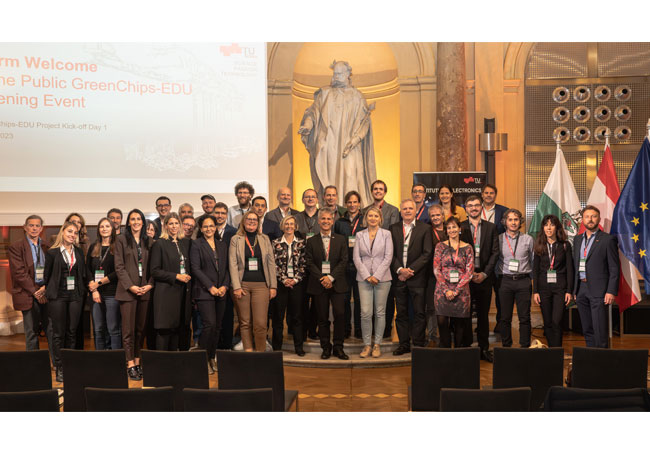
The Graz University of Technology (TU Graz) is implementing an international project that brings together 15 universities, companies and research institutions in order to train urgently needed specialists for the semiconductor industry. Author Philip Jarke stated in his contribution dated 31.10.2023 that the European Union (EU) participates in the financing of this project in the amount of EUR 7.15 million.
The European Chips Act is meant to take the European microchip industry to a new level. Several billion euros will be invested in the construction of new semiconductor plants in Germany, Poland and Italy. A large number of engineers and technicians are needed to operate these new high-tech sites, and it is still not clear where these skilled workers will come from. The electronics industry already lacks qualified personnel.
In Austria alone, there is a shortage of an additional 14 000 skilled workers. In Europe, the need is estimated at between 60 000 and 150 000!
Seven European universities have joined forces with eight other partners from industry and research in the "GreenChips-EDU" project to specifically address this shortage of skilled workers. Together, they would like to support, in particular, the training of specialists in the field of microelectronics. The European Commission (EC) is funding this four-year project with €7.15 million and the Austrian Research Agency (FFG) is adding another €750,000.
Project Manager Bernd Deutschmann, Head of the "Institute of Electronics at the Technical University of Graz" said: "The decisive factor in deciding on the location of production in the microelectronics industry was the cost of production. Today, microchips are being developed and manufactured where there are specialists. With the 'GreenChips-EDU' project, European universities are joining forces for the first time to develop a common curriculum for training in electrical and microelectronics engineering and thus train the necessary specialists from technical universities in Europe in the best possible way."
Energy efficiency and sustainability in power electronics
The focus of the study programmes will be on the development and production of sustainable and energy-efficient microchips, as energy-saving microchips are essential to achieve Europe's climate goals. Bernd Deutschmann added: "The focus is mainly on power electronics. Europe is an international leader and badly needs the staff we want to qualify young people for."
Internationally harmonised study programmes facilitate cross-recognition of learning outcomes at borders and promote student mobility. The "GreenChips-EDU" project also shows the importance of international university networks. HERE Graz is part of the "European University Alliance" (Unite!) and several partners in the "GreenChips-EDU" project are also members of "Unite!".
Andrea Höglinger, Vice-Rector for Research at TU Graz, said: "A good network with excellent partners from science and business makes such a project possible. Six of the seven universities are members of the 'Unite!' network, a strategic alliance of nine technical universities in Europe."
Bernd Deutschmann further added: "Our goal is for 600 students to complete a bachelor's or master's programme over a four-year project period." Master's programmes should be maintained after the end of the project period. In addition to study programs, "GreenChips-EDU" also develops training courses for further and higher qualifications of qualified workers from industry. The spectrum ranges from short workshops to microcredit programs to MBA programs.
Final theses in cooperation with companies
In addition to universities, the association and the research institute, six companies are also involved in "GreenChips-EDU", including "Infineon Technologies Austria" and "Končar" from Croatia. Industrial partners are involved, among other things, through teaching tasks and cooperation on diploma theses.
Sabine Herlitschka, CEO of "Infineon Technologies Austria", comments: "Microelectronics is a huge lever for achieving climate goals, thus contributing to decarbonisation and digitalisation. More than ever, qualified technical experts are needed to implement these impressive innovations such as reducing emissions and realising the huge potential of energy efficiency. These are very attractive job opportunities that can shape a better future. "GreenChips-EDU" will help develop current and targeted curricula to attract more young people to technical studies. In the coming years, Infineon Technologies Austria will contribute in particular with its extensive expertise in the research, development and production of energy-saving chips, as well as its training activities for more than 100,000 young people. Together with this competitive consortium, we will inspire enthusiasm for technology, promote education and train technical specialists for the future. This is a very concrete initiative to strengthen the European Talent Pool in this highly relevant area of microelectronics."