
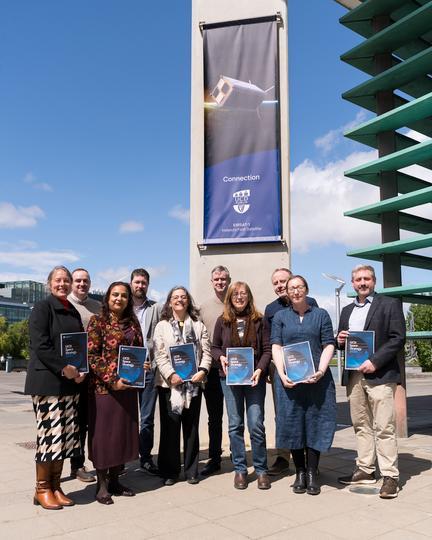
University College Dublin (UCD) launched its Space Strategy to 2030, calling for Ireland to hold outsized ambitions for its future in the trillion dollar global space sector.
The strategy offers an ambitious blueprint to position Ireland as a national and European leader in space research, innovation and higher education, driving discovery through interdisciplinary excellence and sustainability.
Among its five principal objectives, the university called out its aim to secure €30 million funding for a national Space Research, Development and Innovation (RDI) Centre, and to establish two internationally recognised space education and skills development programmes within the next four years.
Speaking at the launch, UCD Vice-President for Research, Innovation and Impact, Prof Kate Robson Brown said: “Space is more than a research theme – it is a dynamic arena where we address the great scientific, industrial and societal questions of our time. With this strategy, we call on our community at UCD to lead with purpose and be ambitious for Ireland in this powerful sector. There are great opportunities in space for a small nation to achieve big things.”
Professor of Astronomy and Director of UCD C-Space Centre, Prof Lorraine Hanlon said: “The strategy we’re launching today builds on our significant heritage in space-related research, innovation and education, and offers a blueprint for the development of many new and exciting activities across multiple domains – such as Space Life Sciences, Space Instrumentation, Advanced Materials, AI-space data enabled technologies – new strategic partnerships, and exciting opportunities for our students. We are very proud of the legacy UCD has built and we look forward to showing where that can take us in the new space race.”
The strategy is built around four primary action areas:
- Fundamental and Interdisciplinary Research and Strategic Partnerships: Leveraging UCD’s strengths in astrophysics, engineering, computer science and life sciences to lead international space missions and instruments.
- Advanced Infrastructure: Developing state-of-the-art facilities, including spacecraft testing and assembly facilities, cleanrooms and laboratories, satellite ground stations and mission-control centres.
- Education and Skills: Expanding the national talent pipeline through world-class programmes such as UCD’s MSc in Space Science and Technology and establishing new internationally recognised degrees by 2030.
- Policy Leadership: Shaping the future of Irish and European space-related policy, guiding investment and international engagement to achieve sustainable benefits for national industry and society.
With the global space economy expected to exceed $1.8 trillion (€1.5 trillion) in the next decade, UCD’s strategy focuses on high-growth sectors such as optical communications, autonomous smart satellites, and AI-enabled Earth Observation.
Through UCD Centre for Space Research (UCD C-Space), the university will bridge the gap between academia and industry, unite scientific exploration with policy leadership and industrial application, ensuring that space technology serves as an engine for long-term innovation, climate resilience, and economic competitiveness for Ireland.
https://www.ucd.ie/research/news/2026/ucdspacestrategy2030chartsambitiouscourseforireland