
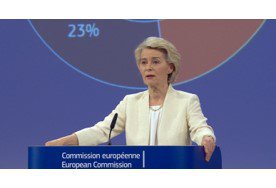
On 16 July 2025, European Commission President Ursula von der Leyen presented the European Commission's proposal for the next Multiannual Financial Framework (MFF), amounting to almost € 2 trillion (or 1.26% of the EU's gross national income on average between 2028 and 2034).
Against the background of an increasing number of challenges in numerous areas such as security, defence, competitiveness, migration, energy and climate resilience which Europe is facing, the Commission proposes a fundamental redesign of the EU budget, which, it says, will be more streamlined, flexible and impactful and will significantly enhance the EU's capacity to deliver on core policies while addressing new and emerging priorities. Furthermore, the Commission states that a modern EU budget requires modernised and stable sources of income, and is therefore proposing new own resources and adjustments to existing ones.
According to the Commission, the key features of the new MFF are:
- More flexibility across the budget, so Europe has the capacity to act and react fast when circumstances change unexpectedly or when new policy priorities need to be addressed.
- Simpler, more streamlined and harmonised EU financial programmes, so that citizens and companies can easily find and access funding opportunities.
- A budget tailored to local needs, with National and Regional Partnership Plans based on investments and reforms, for targeted impact where it matters most and ensuring a faster and more flexible support for more economic, social and territorial cohesion across our Union.
- A powerful competitiveness boost, for Europe to secure supply chains, scale-up innovation and lead the global race for clean and smart technology.
- A balanced package of new own resources that ensures adequate revenues for our priorities while minimising pressure on national public finances.
From the research and innovation perspective, the new European Competitiveness Fund, worth € 409 billion, will invest in strategic technologies, to benefit the entire Single Market, as recommended in the Letta and Draghi Reports. The Fund, operating under one rulebook, and offering a single gateway to funding applicants, will simplify and accelerate EU funding and catalyse private and public investment. It will focus its support on four areas:
- clean transition and decarbonisation;
- digital transition;
- health, biotech, agriculture and bioeconomy;
- defence, and space.
The Commission stresses that the Fund will maximise the impact of every euro spent by drawing in private money.
In close connection with the European Competitiveness Fund, the EU research framework, with its flagship Horizon Europe worth EUR 175 billion will continue to finance world-class innovation. The EC emphasises that Horizon Europe and the Competitiveness Fund will offer support for the entire investment journey of a project (from conception phase to scale-up) and reduce both the cost for potential beneficiaries and the time for disbursement.
In her statement on presenting the MFF budget, Commission President von der Leyen stated regarding the ECF:
We propose a European Competitiveness Fund with close to 410 billion EUR, because it is crucial to back the strategic technologies of tomorrow. This Competitiveness Fund includes a doubling of Horizon Europe, our flagship programme for science and innovation. We multiply by 5 our investment in digital to build a secure and innovative digital ecosystem. And we make major boosts in clean tech, the bioeconomy and decarbonisation with a 6 times increase of the funds from the EU budget, funding these topics. […] Third, building a Union that protects. We are proposing 131 billion EUR for the Defence and Space window within the Competitiveness Fund. That is 5 times what we have today.
https://ec.europa.eu/commission/presscorner/detail/en/ip_25_1847