
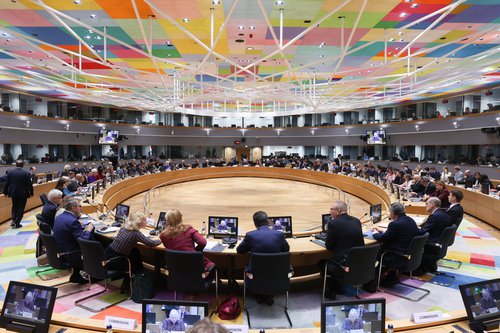
At the Competitiveness Council (Research) on Tuesday, 30 September 2025, the EU ministers responsible for research held a policy debate on the Horizon Europe Package (2028-2034), focusing on the topic of “EU research and innovation for dual use, security and defence”. In addition, two sets of Council Conclusions were adopted: one on the importance of research and innovation for the EU Startup and Scaleup Strategy, and another one on a call for action on life sciences for the Union’s competitiveness. The informal lunch debate was dedicated to Europe’s ambitions in the field of research and technology infrastructures. The meeting was chaired by Danish Minister for Higher Education and Science, Christina Egelund, under the Danish Presidency of the Council of the EU. The European Commission was represented by Commissioner Ekaterina Zaharieva, responsible for Start-ups, Research and Innovation.
The first set of Council Conclusions emphasises the strategic role of research and innovation in supporting the EU’s Startup and Scaleup ecosystem. Based on the EU Startup and Scaleup Strategy ‘Choose Europe to start and scale’ it highlights the need for stronger links between cutting-edge research, innovation ecosystems, and access to finance, particularly for deep-tech and science-based startups. The second set of Council Conclusions calls for targeted action in the field of life sciences, recognising their growing role in addressing global health challenges, ensuring industrial competitiveness, and strengthening Europe’s strategic autonomy. The Conclusions stress the importance of a coordinated policy approach across the R&I landscape, industrial policy, health systems, and skills development, to fully unlock the potential of life sciences for Europe’s economy and society.
During their policy debate on the Horizon Europe Package for the next Multiannual Financial Framework (MFF, 2028-2034), ministers explored how EU research and innovation can better support dual-use technologies, and contribute to Europe’s security and defence priorities. This topic has gained renewed attention in the context of growing geopolitical challenges and Europe’s ambition to strengthen its resilience and technological leadership. “The proposal to include dual use and projects with a focus on defence application in the next Horizon Europe requires thorough consideration of e.g. impact, new stakeholders involved in projects, handling of sensitive data, cooperation with third countries and security aspects”, the Danish Presidency emphasised in a Presidency Note.
Under Any Other Business, Commissioner Zaharieva presented the 2025 Annual Progress Report on Simplification, Implementation and Enforcement of EU research policy. She also introduced the recently published European Strategy on Research and Technology Infrastructures, adopted by the Commission on 15 September 2025. The strategy outlines a roadmap for modernising and better coordinating Europe’s R&I infrastructure landscape, with a focus on open access, excellence, digitalisation, and sustainability.
The informal lunch was dedicated to Europe’s ambitions in the field of research and technology infrastructures. “The importance of research and technology infrastructures in the EU has become even more apparent with the shifting geopolitical climate, where European actors increasingly need to be attentive to possible challenges, such as losing access to research data and infrastructures in critical areas”, the Danish Presidency stated in a Presidency Note.
The next formal meeting of the Competitiveness Council (Research) will take place on 9 December 2025 in Brussels. The Danish Council Presidency is preparing an ambitious progress report on the Horizon Europe Package. In addition, ministers are expected to adopt the revised Regulation on the EuroHPC Joint Undertaking, aimed at supporting the implementation of AI Gigafactories and the EU Quantum Strategy.
For more information: