
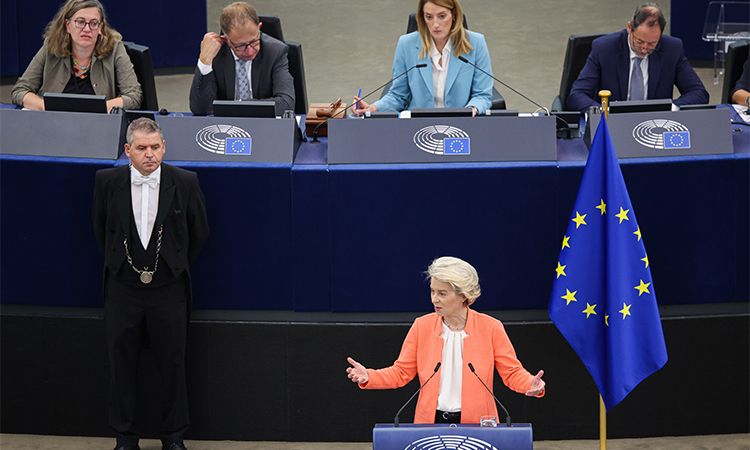
Responding to the speech, Iliana Ivanova, who is set to become the EU’s next research and innovation commissioner, said on social media that “R&I policy is fundamental for our long-term competitiveness”.
“Remaining a technological leader in the global race depends on an ambitious R&I, in support of European businesses in strategic technologies,” she added. On the supercomputing announcement, she said: “Our supercomputers will put European R&I startups in pole position globally for a stronger EU science and technology base.”
MEP Christian Ehler, a senior figure in the Parliament’s research committee, said that the address was a “turning point” and had industrial policy at its heart, agreeing that there is a need to “focus on competitiveness” in decarbonisation efforts.
He said that attempts to ensure a level playing field for industry “will require investments in science, research and innovation. It will also require that we make science and engineering careers more attractive in Europe, because we face an unprecedented brain drain which will undermine all our industrial ambitions.”
Kurt Deketelaere, secretary-general of the League of European Research Universities, said it was a “strong and ambitious” address, “announcing a continuity of present economic, climate, tech and digital policies, driven by strategic autonomy”. But he added: “A stronger emphasis on the role and need of EU frontier R&I for all of that would have been welcome.”
Meanwhile Thomas Jørgensen, director for policy coordination at the European University Association, said the university sector should not “get carried away” by the address “ignoring research and education”, insisting that “there is a big role to play for us in all the challenges mentioned, from skills to enlargement”.
This brought the agreement of Jan Palmowski, who leads on Africa-EU relations for the Guild of European Research-Intensive Universities. He added that it was “excellent to see strong commitment to EU-African Union cooperation based on genuine partnership”.